Tuesday, April 03, 2007
Hi from an internet cafe in Chania, funky music within and bright sun outside. Here's some notes from the wayside:
We arrived in Chania in Lent and find the town uncurling like a feral cat, readying for the season ahead. In fact the stray cat image feels a good one - it fits the tawny tones of the buildings in the sun and also certain abjectness despite its charm. In our 8 days here we've met some really great people - friendly & informative (everyone here can respond in near-immaculate English to our halting Greek phrases) and had a fascinating time wandering the old town and harbour but there seems an undercurrent of cultural pain half-hidden under the daytime picturesque glamour and the nighttime glitz. You don't have to examine the museums to realise these peoples' identity is bound up with their long history of invasions. Arabs, Byzantines, Venetians, Turks, they came in turn to brutalise Chania, and then the Germans bombed it. Ruined buildings rubble spills from every alley, romanticised by crown daisies and chamomile but the aura of dereliction persists.
And the next wave of incursion is us, the tourists. It's shaming to see huge hoardings in English urging cheap holiday homes for sale, built haphazardly on these lovely headlands, and fly-posters in Greek protesting "Trees not cement." Garbage homes, our landlord Alex calls them; he's despairing of the adminstrative lack of foresight that's allowing the ruination of this beautiful land.
But that's only one side of it. There's a lot more to do here than sombre pondering. I'm writing an article on travelling on a budget and Peter has made contact with the Agrokiepiou, a research garden for Crete's endangered plants. We're doing loads of walking - the wild flowers are fantastic, persian-rugging wasteland right to the rockiest coastal rim. We've been beachcombing for ceramic debris along the old Minoan ramparts.
We've tasted stewed wild greens with an organic campainer and watched Greece beat Malta with the souvlaki bar regulars. We've watched dawn behind the minaret and sunset over the sea. 

We've searched out places which are comfortably untouristy (not ethno-snobbery: just that we're not dressed to promenade & don't have the funds for the 4-language-menu restaurants) and we pad around our favourite patches as well as exploring.
And our apartment is brilliant: cheap, clean, and spacy, with a sunny balcony and surprising number of mod.cons - like hot & cold air conditioning,50 channel TV, and - bliss - a hairdryer. We've got the use of a little gaz stove and the local shop is cheap'n'cheerful, as is the souvlaki bar next door. And of course we've splashed out a bit too... The weather's been variably warm but blue skies predominate; fingers crossed cerulean rules for lap 2. We're heading next for the south coast, to spend Easter week in Plakias.
Saturday, March 24, 2007
Spring, having sprung, sprang abruptly backwards. Undeterred - well, deterred but fleecily-wrapped - Hazel and I set off on a Sunday visit to Stourton Garden (not recommended; as Hazel put it:" There's something about struggling beauty choked by wildness which is profoundly poignant, but charging £3.50 for the privilege of walking round this site of devastation is bare-faced cheek") and a plod around Alfreds Tower in between bursts of sleet. The week stayed icy cold for our Equinox celebrations - burning detritus of the past as well as invoking new beginnings.
And this is where Peter and I are headed now... I kept going to Do-I-Need-A-Jacket-dotcom to check that No, I don't - because in Crete the air really is 10 degrees warmer than here...
I don't plan to blog much while in transit; this is essentially a notebooks-and-pen trip, as we're backbacking along coastal paths with minimum rucksack load.
So, updates will be sparse and - until I get back - imageless. Normal service will resume in May. (Just keep telling funky-poetry-fans about onomatopoeia, now at 343 views.) Last word to Mike - with thanks for the lend of a picturecard so's I can store cerulean images by the score: "Life is not measured by the number of breaths we take, but by the moments that take our breath away."
Enjoy April! Peter & I will.
I don't plan to blog much while in transit; this is essentially a notebooks-and-pen trip, as we're backbacking along coastal paths with minimum rucksack load.
So, updates will be sparse and - until I get back - imageless. Normal service will resume in May. (Just keep telling funky-poetry-fans about onomatopoeia, now at 343 views.) Last word to Mike - with thanks for the lend of a picturecard so's I can store cerulean images by the score: "Life is not measured by the number of breaths we take, but by the moments that take our breath away."
Enjoy April! Peter & I will.
Saturday, March 17, 2007
Also this week:
two excellent Writers Circle meetings, a Frome Writers Self-Help Group discussion, writers' supper with Alison, and on Friday it was Little Miss Sunshine dvd night. I often find it difficult to make distinctions between personal events and 'a writer's life', my self-set blog-brief - what's differently nourishing for a writer than for a person? I've had wonderful moments with friends and family but as Luke Wright says, a blog is not a private journal. So even though I don't spend much time shaping or filing these thumbnail experiences, they're all rooted somehow in the process of writing. A lot that I've enjoyed gets sifted out, but Little Miss Sunshine can stay. My favourite films all seem to be about dysfunctional outsiders, or else road movies; here's both rolled into one with humour, charm, and an enfant-sauvage indictment of US cultural values.
And apropos writing, thanks Luke for the pro-Frome puff - and thanks to the 312 viewers of onomatopoeia!
Wednesday, March 07, 2007
Thursday was Brian Patten's reading. I've been a Liverpool Poets groupie since the '60s, and Patten was always my best of band. The waif-like angelswithdirtyfaces beauty has solidified somewhat but the voice has the same sandy softness, almost too tactile for everyday use. And the poems are still wonderful. That dress won't stop you growing older... written five months ago, has the same gentle erotic sadness as 'Into my mirror has walked' from 40 years ago. And the same honesty.
Monday, March 05, 2007
Checking my onomatopoeia clip, I'm pleased to see it's clocked up 199 hits now - and Howard has put 3 more DVD tracks on Youtube: Local Honey, Hot Night, and What's it like for you? They're all short, and need some more hits so do take a quick look.
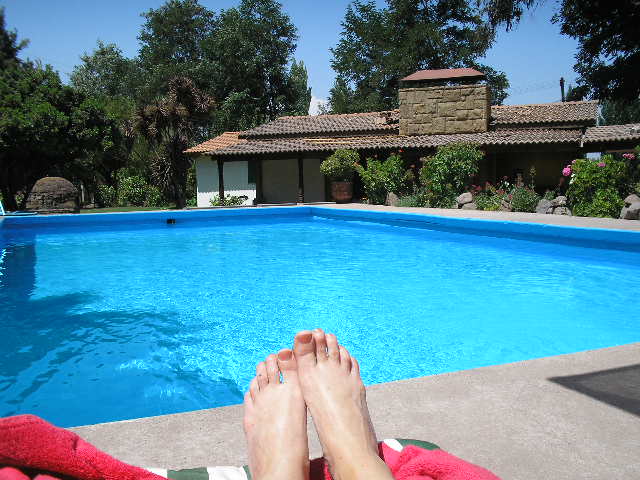
Workshop at Centerparcs last week gave me a chance to defy the drizzle in the wild water rapids but I'm hoping we'll see a bit more sun in Chania (puerile link I know but I wanted to use the pic).
Tuesday, February 27, 2007
One of the reasons Frome’s Merlin Theatre is seen as a model of good practice is director Paula’s determination to gather a diverse creative team and then to nourish them. The annual Merlin Salon fr’instance, and as Nicki from the deli did the catering we were particularly well-nourished at the Orchardleigh work-party this week, with less than a hyphen separating the work from the party.
Saturday, February 17, 2007
A flurry of excitement in Cheap Street on Saturday as best-selling author Debby Holt does a book-signing at Hunting Raven bookshop. Frome, as well as 2 thriving theatres and a licenced cinema, has its own independent book shop - recently extended, an'all, so everything the writer needs really. 
I can feel one of my Frome-twinned-with-Eden moments coming on - well we are at the heart centre of the universe in ley-line terms, apparently, and Simon Pegg mentioned us in a Hot Fuzz interview - so I'll add a quick burble about our cool cafe society and a pic from the lovely Parisien night at Christies:
Some things recur inexplicably. Like James Blunt, and summer barbecues (wow, it’s hot today, let’s light a fire!). Another of these is the question “Can creative writing be taught?” Like a persistent knotweed it burst forth in the Readers’ Page in last Saturday’s Guardian - which I’d only bought because the Guide carried a rave review of Luke Wright’s new tour, coming to the Merlin on March 10th. (click on 'gigs' at his site to book)
But back to the question, and in particular the way in which Keats’s famous quote “If poetry comes not as naturally as the leaves to a tree it had better not come at all” is wheeled out to support the Case Against. Why? Keats might have meant poetry needs to grow from experiential processes not intellect. He might have meant that when he’s not in the mood he can’t force his words to the quality he wants. He might have meant it needs to take its time unfurling, or that it should be free of self-conscious affectations. What he’s unlikely to have meant is that writers should not attempt to learn their craft like any other artist.
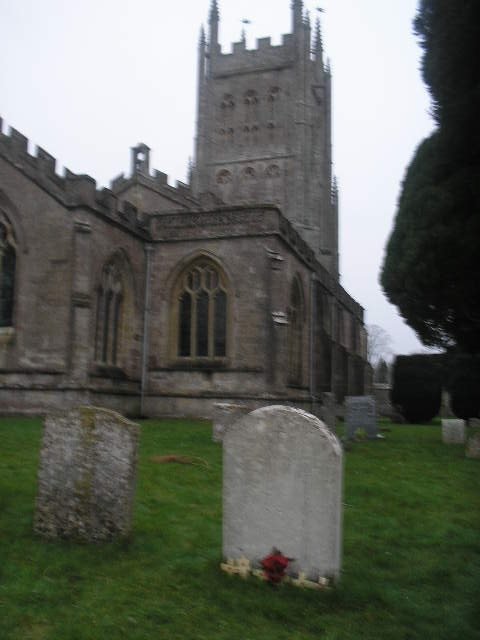
Which links me in a raggy sort of way to our walk on Sunday through Vallis, snowdrop tiers luminous and exquisite all along the riverside, to revisit the grave of Siegfried Sassoon in Mells. Sassoon was a mentor to Wilfred Owen and even helped to edit Anthem for Doomed Youth, changing, our friend Gloria tells us, the mourning wail of shrill choirs of shells from “demonic” to “demented”. Both anthropomorphic, but maybe the original was more phonically apt? Still, at least it shows that Owen was open-minded about guidance.And Wednesday (21st) was the centenary of WH Auden, the poet with a passion for humanness. We've been revisiting his words. 'Lay your sleeping head my love' is the most exquisite tribute to ordinary love I've ever read, and Emily reminds me of another: September 1st 1939: There is no such thing as the State, And no one exists alone...We must love one another or die.
Monday, February 12, 2007
New moon, Hare moon, and a week of highs - (Venus at the movies, 7/10 I'd say, would be more but for sentimental longwinded ending; sunny walks; shards of snowdrops) - and lows (24 hour lurgi...yucch).
Big buzz to find Howard's put a track from our DVD on YouTube. I give it max. rating and add it to my favourites. Wish someone else would. Son No.2 thinks it "too weird" his mum is in a pop video, and I can see his point.
ps Thank you, Luke Wright!
February 13th is "Valentine Vices", a Poetry Cafe night after a long gap. A great night. Our guests - Rose Flint and Gordon Egginton - are fabulous. And we have David Johnson, of Bristol's 'Paralalia' and Dave Angus from Bath's 'What a Performance' nights... and 15 other poets, all sharing authentic, moving, funny, outrageous experiences with us. Debut reader Tracy Wall won everyone's heart, and one of the awards, with her gymnastic musings. I feel humble and immensely proud as I hand out the donated gifts: a red rose, theatre tickets, books, candle and scented sachets. Valentines Day may have been snaffled by commercial cynics, but there's still a chance to reappropriate. With words.
On Thursday I went with Emily & Ben to Theatre Royal Bath for the National Theatre production of The Seafarer. It's only on till Saturday, or I'd say GO. It's stunning. No sea, although a strong sense of lone voyage. Conor McPherson, who directed and wrote the play, has a skill with script that makes the programme note that “He writes dialogue as if he has found it in the mouths of his characters” read like humble truth. This is a play about redemption, really. There is failure and human frailty but in the end redemption comes through ordinary dysfunctional things like family and friendship, and accepting ownership of your life. Here, hell is not other people, but having no-one to love you. This is an extraordinary story, from the celtic tradition but as uptodate as mobile phones and Miller Lites... and timeless as the devil himself.
And we’re doubly lucky: there’s an after-show talk giving insight into the process that has created this powerful piece of theatre. The actors made contributions during rehearsal time, though now it’s all nailed down, Jim Norton says. ”We try to give the impression of extemporising, but it’s all exact - like jazz”. The other men nod. “He’s a good director.” “He’s the best.” They quaff their drinks. Once again they seem like their stage characters.

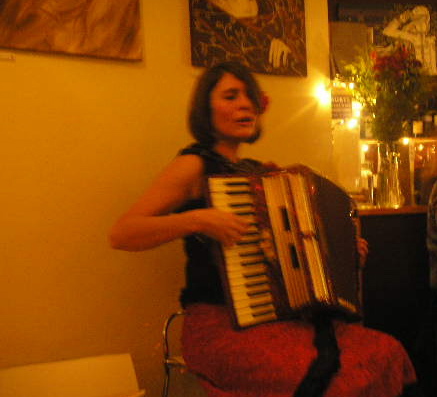
A good end to the week with the first session of the newly-formed Frome Self-Help Writers Group - perhaps we should have found a title like Frome Readable Oddities Group Self-helping People All Writing Now which would give us a better acronym - ably and elegantly led by Alison Clink. Small group, good atmosphere, great range of work. And rounding the working week off nicely, convivial supper and then great music (Tessa Bickers my favourite) at the Acoustic-Plus.
Big buzz to find Howard's put a track from our DVD on YouTube. I give it max. rating and add it to my favourites. Wish someone else would. Son No.2 thinks it "too weird" his mum is in a pop video, and I can see his point.ps Thank you, Luke Wright!
February 13th is "Valentine Vices", a Poetry Cafe night after a long gap. A great night. Our guests - Rose Flint and Gordon Egginton - are fabulous. And we have David Johnson, of Bristol's 'Paralalia' and Dave Angus from Bath's 'What a Performance' nights... and 15 other poets, all sharing authentic, moving, funny, outrageous experiences with us. Debut reader Tracy Wall won everyone's heart, and one of the awards, with her gymnastic musings. I feel humble and immensely proud as I hand out the donated gifts: a red rose, theatre tickets, books, candle and scented sachets. Valentines Day may have been snaffled by commercial cynics, but there's still a chance to reappropriate. With words.
On Thursday I went with Emily & Ben to Theatre Royal Bath for the National Theatre production of The Seafarer. It's only on till Saturday, or I'd say GO. It's stunning. No sea, although a strong sense of lone voyage. Conor McPherson, who directed and wrote the play, has a skill with script that makes the programme note that “He writes dialogue as if he has found it in the mouths of his characters” read like humble truth. This is a play about redemption, really. There is failure and human frailty but in the end redemption comes through ordinary dysfunctional things like family and friendship, and accepting ownership of your life. Here, hell is not other people, but having no-one to love you. This is an extraordinary story, from the celtic tradition but as uptodate as mobile phones and Miller Lites... and timeless as the devil himself.And we’re doubly lucky: there’s an after-show talk giving insight into the process that has created this powerful piece of theatre. The actors made contributions during rehearsal time, though now it’s all nailed down, Jim Norton says. ”We try to give the impression of extemporising, but it’s all exact - like jazz”. The other men nod. “He’s a good director.” “He’s the best.” They quaff their drinks. Once again they seem like their stage characters.

A good end to the week with the first session of the newly-formed Frome Self-Help Writers Group - perhaps we should have found a title like Frome Readable Oddities Group Self-helping People All Writing Now which would give us a better acronym - ably and elegantly led by Alison Clink. Small group, good atmosphere, great range of work. And rounding the working week off nicely, convivial supper and then great music (Tessa Bickers my favourite) at the Acoustic-Plus.
Monday, February 05, 2007
"As the light lengthens, so the cold strengthens"Last weekend was Imbolc, the Celtic festival of new beginnings. Appropriately for a celebration about the growing power of the sun, Saturday in Glastonbury was a stunning day, warm as summer and with a vivid cobolt blue sky. A magic day, full of personal affirmations as we spiralled around the tor and revisited the holy thorn, which we found decorated with pagan tributes of mistletoe as well as a tiny corn angel. Perhaps this is St Brigid, who is patroness of fertility and poetry. As saints go, Brigid seems to have retained remarkable primitive powers. Everywhere she walked, flowers sprang up under her feet. A goddess of poetry, Brigid invented the Ogham alphabet, and on Brigid’s Night 'the sombre hag who took possession of the year at Samain is replaced by the smiling one of hope, full of virginal gaiety, beauty and promise.' Sounds good to me.
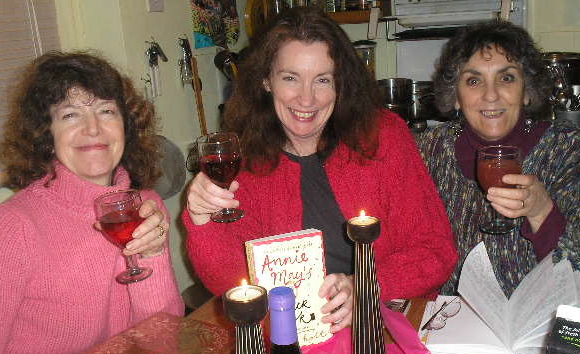
"I think I've finished book 4" Debby Holt says at our monthly meeting at Emily's. Book 2 - Annie May's Black Book - has only just been launched, and immediately rocketed into the top 50 best sellers, so this deserves celebration.What else is new. On Monday the Frome Writing Self-Help Group met again, this time meeker and more mutually attentive. Having now come to heel like docile pups after a Barbara Moorhouse training session, we lolloped through the empty spaces of Wendy's projected programme, filling each date with themes and facilitators. The focus remains firmly on self-help; the general feeling is that the group will find its own direction and energy as it develops. Sessions are open to any interested writer but places limited: sign up at the Library to ensure participation. By contrast Frome Writers Circle, now a vintage group compared to the young wine of the FWSHG, in our Tuesday meeting were able to appreciate the advantage of a smaller group: just 4 (excellent) stories shared but with enough time for full discussion.
With my feet back firmly on Somerset soil (how thick and moist the grass looks here)- a contrastive moment from 2 weeks ago. Providencia, uptown Santiago. I'm scurrying across the busy road without waiting for the traffic lights' permission. Bus driver starts honking his horn. Other drivers join in, long fingers on the noisy pulse as they pass. I'm shaking. I wasn't doing anything that dangerous, surely. Why are these latino drivers such sticklers for pedestrian discipline? I find out about the earth tremor later - the horns are used as a quake warning. No wonder I felt shaky.

2 more fragments from my Chile journal:
An acrostic:
City girl, small town elder
Reading my friend, writing my life
Yet still unsure what it's all about.
Scribbling, scribing
Searching, hiding
Elusive answers. Maybe the question is the point.
The other is a line from Rilke:
"The future enters us to transform us long before it happens."
Wednesday, January 31, 2007
A swarm of writers landed on Frome Library on Tuesday. Wendy Miller-Williams, who will shortly be canonised for beatific services to local literature, put on her bee-veil and dealt with the buzz of the newly-formed Self-Help Writing Group - louder than a children's party, more chaotic than Railtrack - and hived us off into some sort of order. The Words@Frome Festival committee reconvened, the Poetry Cafe promo is out and so are my snowdrops. Spring is nearly sprung, but I seem to be still circling somewhere above Santiago.
I can still smell the exotic strangeness of sun and smog and eucalyptus. I still hear the ceaseless birdsong, taste the fresh figs, feel the velvet smoothness of the water at dusk. I remember the night we saw the comet like a long silver smear across the sky, the snake on the road that day I borrowed the mountain bike and cycled to the village.
I look back at my journal. The day we went to Yerba Loca, in the mountains.
Picnic of watermelon. Tortolita flitting in the trees above us - are they morning doves or mourning doves? Here we're 2000 feet above sea level, high above the dust road, yet the meadow is moist and scattered with flowers like a Klimpt painting. The Californian poppies and orange orchids have given way to tiny blue and white alpines, yellow of hawkweed and some little scrambling butter-golden trumpets. Tall creamy white umbellifers. Butterflies with black & white chequer board wings. River below me, thundering constantly. Mountains ahead, mountains behind, their white muzzles biting into the voracious blue sky. Rocks, grey, stubborn in this soft green verdancy, sudden and obdurate. "You'll never meet anyone in the rest of your life who has been here," says Susan.

We were talking, one day at happy hour, about why we write. It was Sandra’s question. For her: curiosity and challenge. For Merle, creativity. Frank: to say something. Susan simply enjoys it, more than anything else she does. For me it’s like breathing, it’s how I process my life, how I know myself.
Interestingly, as Sandra pointed out, none of us said “To be published, to be famous.”
The question for a writer, I suggest, is: how much do you want to share your writing? And how much of it do you want to share?
I can still smell the exotic strangeness of sun and smog and eucalyptus. I still hear the ceaseless birdsong, taste the fresh figs, feel the velvet smoothness of the water at dusk. I remember the night we saw the comet like a long silver smear across the sky, the snake on the road that day I borrowed the mountain bike and cycled to the village.
I look back at my journal. The day we went to Yerba Loca, in the mountains. Picnic of watermelon. Tortolita flitting in the trees above us - are they morning doves or mourning doves? Here we're 2000 feet above sea level, high above the dust road, yet the meadow is moist and scattered with flowers like a Klimpt painting. The Californian poppies and orange orchids have given way to tiny blue and white alpines, yellow of hawkweed and some little scrambling butter-golden trumpets. Tall creamy white umbellifers. Butterflies with black & white chequer board wings. River below me, thundering constantly. Mountains ahead, mountains behind, their white muzzles biting into the voracious blue sky. Rocks, grey, stubborn in this soft green verdancy, sudden and obdurate. "You'll never meet anyone in the rest of your life who has been here," says Susan.

We were talking, one day at happy hour, about why we write. It was Sandra’s question. For her: curiosity and challenge. For Merle, creativity. Frank: to say something. Susan simply enjoys it, more than anything else she does. For me it’s like breathing, it’s how I process my life, how I know myself.
Interestingly, as Sandra pointed out, none of us said “To be published, to be famous.”
The question for a writer, I suggest, is: how much do you want to share your writing? And how much of it do you want to share?
Monday, January 29, 2007
How was Chile?


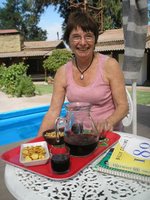
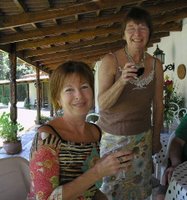
Fifteen creative writers, all far from their homelands of England, Canada, Holland, South Africa, Japan and Singapore. Our hostess and course organiser is Susan from England. The theme of transition is resonant; their words are fascinating. We work around a long table in the shade of the sala throughout the morning, then after al fresco lunch, the afternoon is free to read by the pool, swim, or walk around the parcela - smallholding - which comprises vineyards, fields of cattle and horses, and a small hill. As the afternoon sun becomes more gentle and the Evening Primrose flowers unfurl again, Susan appears with a tray of wine and tapas and announces Happy Hour. We reconvene, talking of poetry and publication and other passions, until its time for dinner.
Well that's a typical pattern...
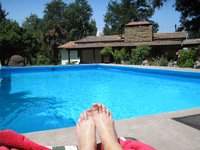
I did other things too - went hiking in the Andes, climbed a path to a glacier, took a trip to the coast and a tour of the crazy coast house of Pablo Neruda, Chile's Nobel Peace Prizewinning poet and favourite son.
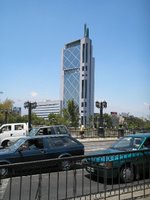
I went on the metro, and the bus, saw the bourgeois side of Santiago and the bohemian quarters, the downtown area and the new malls.
I toured museums and art galleries, sat in coffee bars and a seedy liquor bar, ate Chilean dishes at pavement cafes and in an elegant 15th-storey restaurant.
On the parcela where I stayed I saw amazing wildlife daily - butterflies as big as bats, a huge Great Horned owl like a primitive mask, tiny picui doves, quails dashing along the dust road with their chicks, scores of foraging falcon-like caracara, and listened nightly to the lapwings' screech.
I could go on about the flowers, too: the cactus with their red parasite-blossom, exquisite and deadly, and a kaleidoscope of exotica along the hillsides and verges.
But I think I'll shift focus from these unchanging aspects to what struck me most: the pace of change here.

Acceleration is too slow a word for it. Everywhere I'm reminded of 70s sociologist and soothsayer Alvin Toffler, who warned that change itself is changing. Santiago is a boom town in a boom country.
Half of the population of Chile live here.
Susan's rural paradise is 20 minutes from the biggest mall I've ever seen, including a supermarket with 65 checkouts.
It's one of 29 around the city. The drive begins on a dirt track and joins a 6-lane highway. In one generation the huaso's children are quitting the labour that needs horses and big brimmed hats and flooding to the malls to stand at the checkouts. And prices may look good to the gringo, but here a basic monthly wage is around £100.
Of course it's impossible in 3 weeks to make value judgments, but I can't help being a bit sad to see Pied Piper of Dunkin Donuts and Macdonalds has lured so many children from their traditional culture. It makes me realise when we talk of the pace of change in the UK, we know nothing. Here I met people who had been residents less than a decade ago, now literally unable to recognise their own sector of the city. In a country where tax returns must be submited online not on paper, our parcela didn't even have a working phone as the lines are regularly vandalised for their copper.
On a less Cassandra-like note, and despite the culture shock, I enjoyed every minute of my stay. I saw breathtaking scenery, basked in constant sunshine, met people who were generous and interesting, and above all enjoyed some amazing writing. I'm hoping to add some samples here, but in the meantime will end with a quote from a cafe wall which - now I've got it translated correctly - I intend to use as my motto for this year:
"Sólo quienes se arriesgan en ir más lejos
descubren hasta dónde pueden llegar"
Only those who risk going further discover how far they can really go.


Fifteen creative writers, all far from their homelands of England, Canada, Holland, South Africa, Japan and Singapore. Our hostess and course organiser is Susan from England. The theme of transition is resonant; their words are fascinating. We work around a long table in the shade of the sala throughout the morning, then after al fresco lunch, the afternoon is free to read by the pool, swim, or walk around the parcela - smallholding - which comprises vineyards, fields of cattle and horses, and a small hill. As the afternoon sun becomes more gentle and the Evening Primrose flowers unfurl again, Susan appears with a tray of wine and tapas and announces Happy Hour. We reconvene, talking of poetry and publication and other passions, until its time for dinner. Well that's a typical pattern...
I did other things too - went hiking in the Andes, climbed a path to a glacier, took a trip to the coast and a tour of the crazy coast house of Pablo Neruda, Chile's Nobel Peace Prizewinning poet and favourite son.
I went on the metro, and the bus, saw the bourgeois side of Santiago and the bohemian quarters, the downtown area and the new malls.
I toured museums and art galleries, sat in coffee bars and a seedy liquor bar, ate Chilean dishes at pavement cafes and in an elegant 15th-storey restaurant.
On the parcela where I stayed I saw amazing wildlife daily - butterflies as big as bats, a huge Great Horned owl like a primitive mask, tiny picui doves, quails dashing along the dust road with their chicks, scores of foraging falcon-like caracara, and listened nightly to the lapwings' screech.
I could go on about the flowers, too: the cactus with their red parasite-blossom, exquisite and deadly, and a kaleidoscope of exotica along the hillsides and verges.
But I think I'll shift focus from these unchanging aspects to what struck me most: the pace of change here.
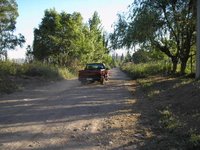

Acceleration is too slow a word for it. Everywhere I'm reminded of 70s sociologist and soothsayer Alvin Toffler, who warned that change itself is changing. Santiago is a boom town in a boom country.
Half of the population of Chile live here.
Susan's rural paradise is 20 minutes from the biggest mall I've ever seen, including a supermarket with 65 checkouts.
It's one of 29 around the city. The drive begins on a dirt track and joins a 6-lane highway. In one generation the huaso's children are quitting the labour that needs horses and big brimmed hats and flooding to the malls to stand at the checkouts. And prices may look good to the gringo, but here a basic monthly wage is around £100.
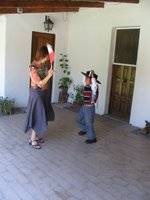
Of course it's impossible in 3 weeks to make value judgments, but I can't help being a bit sad to see Pied Piper of Dunkin Donuts and Macdonalds has lured so many children from their traditional culture. It makes me realise when we talk of the pace of change in the UK, we know nothing. Here I met people who had been residents less than a decade ago, now literally unable to recognise their own sector of the city. In a country where tax returns must be submited online not on paper, our parcela didn't even have a working phone as the lines are regularly vandalised for their copper.
On a less Cassandra-like note, and despite the culture shock, I enjoyed every minute of my stay. I saw breathtaking scenery, basked in constant sunshine, met people who were generous and interesting, and above all enjoyed some amazing writing. I'm hoping to add some samples here, but in the meantime will end with a quote from a cafe wall which - now I've got it translated correctly - I intend to use as my motto for this year:"Sólo quienes se arriesgan en ir más lejos
descubren hasta dónde pueden llegar"
Only those who risk going further discover how far they can really go.
Wednesday, January 03, 2007
Looking ahead -because it doesn't seem right to leave ho-ho-ho imagery on my blog until February, here's a nudge to all poets in striking distance of Frome: Our 'Poetry Café' reopens with a flourish on 13th Feb for 'Valentine Vices' - an evening with the spotlight on personal passion, with Rose Flint, artist, writer, broadcaster and Glastonbury goddess, supported by Gordon Egginton the popular winner of the 2006 Festival Slam, and Frome’s own Lucy Howlett. Open mic and prizes. Email me if you need to know more.
And looking back: Ben and his dad, also a Peter, are recreating one of those touching green-aware dialogues that must been frequent among the conscientious in the aftermath of Christmas:- family member 1 (indignant) "Mum liked the goat!"
- family member 2 (goading) "It never writes."
Subscribe to:
Posts (Atom)